


NEWS
The LTO battery – the maritime workhorse
Release time:
2024-08-26
LTO has historically been misunderstood as heavy and not as energy dense as competing chemistries. However, it more than make up for its lower energy density per kilogram when it comes to building a complete system.
LTO has historically been misunderstood as heavy and not as energy dense as competing chemistries. However, it more than make up for its lower energy density per kilogram when it comes to building a complete system.
Its capability to discharge more of its available energy (depth of discharge – DOD) over a long period of time, means that there is less need for oversizing, or carrying buffer energy to last over the vessels design life. Which in turn mean size and weight can still be lower, compared on a system level.
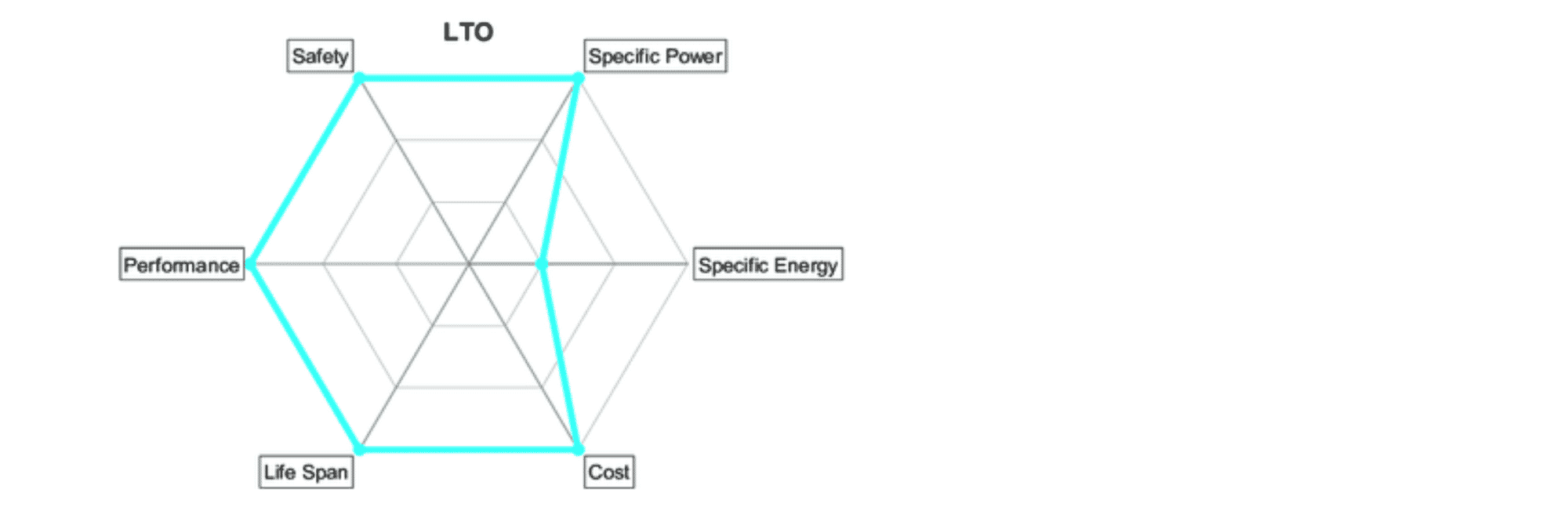
All batteries are tradeoffs between the same six characteristics, defined with this spider chart. LTO boasts superior qualities in safety, power, performance, and life span. Cost is usually higher per kWh, but lower on system level due to better life span and less need for oversizing.
LTO batteries contain lithium-titanium-oxide as anode material instead of graphite. The use of titanium improves the cycle life of the battery and has a better temperature performance, compared to other lithium-ion counterparts.
By using lithium-titanium-oxide in the anode, we achieve a number of positive characteristics, which apart from making it possible to build compact and durable systems, also have implications for battery safety. These are:
No dendrite build-up and no risk for ruptured isolator
Almost zero swelling during charge-discharge (no volume changes)
Rapid charging and low-temperature performance
Self-healing mechanism that prevents short circuit in case of penetration
Relevant information



Main office: Room 501, Building 3, No. 81, Dingye Road, Tangjiawan Town, High-tech District, Zhuhai City, Guangdong Province, China 519000
Manufacturing Center:Zhongneng Science Park, No. 168, Tanlong North Road,Tanzhou Town, Zhongshan, China
R&D and Sales Center in Oxford, UK:47,The Lawns, Kennington Road,Radley,Oxfordshire, UK, OX14 2JR
SAF Coolest v1.3.1.2 设置面板 GAGSD-ZGYF-JFAVE-ZQZ
无数据提示
Sorry, the current column is being updated, please look forward to it!